The theme today is magic, which is convenient, because I have a magic Honda.
Or had one.
Have one.
Fuck.
I don’t actually know which tense to use yet.
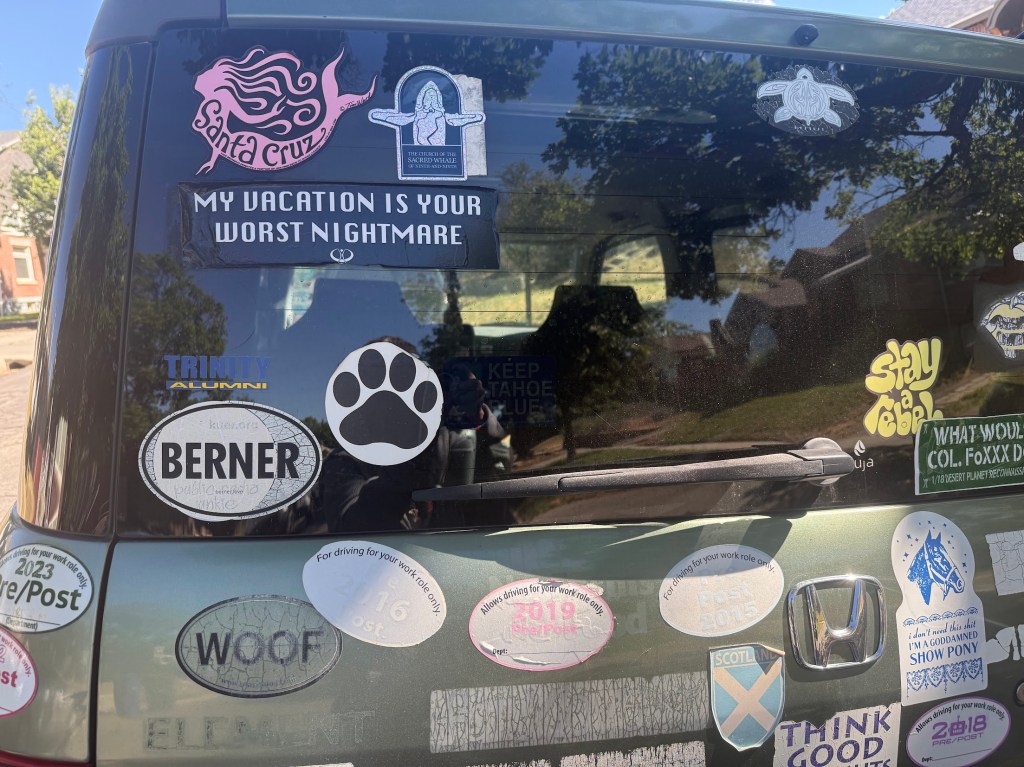
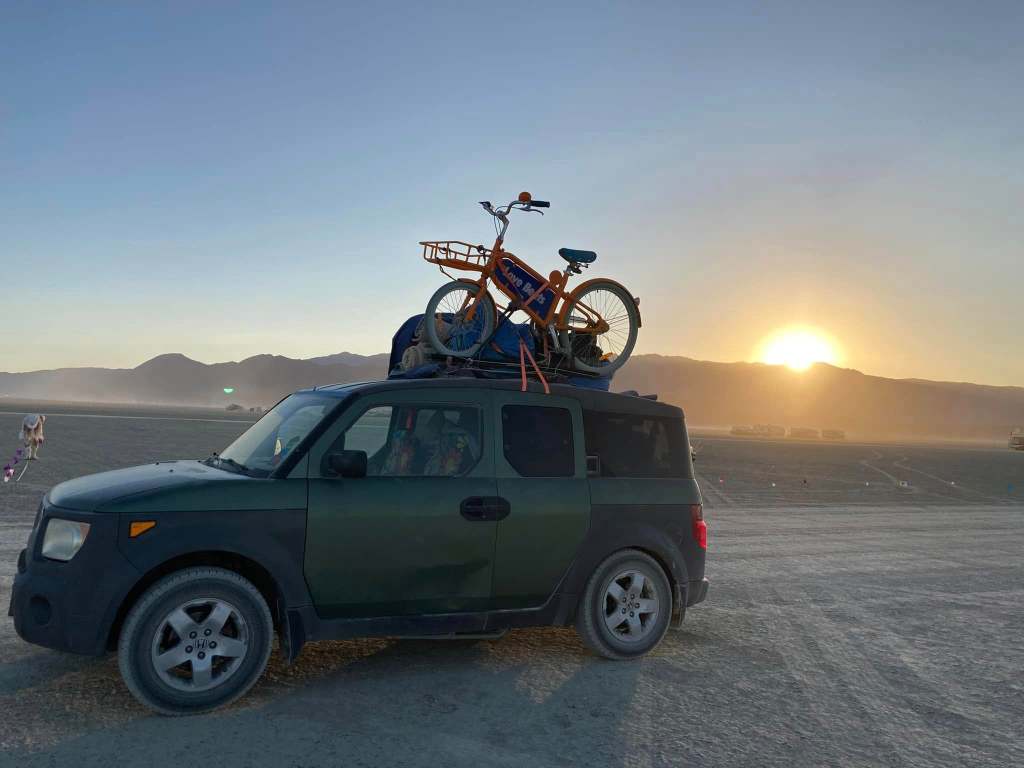
Her name is Wanda, she is a 2003 Honda Element, green more or less beneath twenty-three years of road dirt and political opinions and Grateful Dead stickers and playa dust and whatever else has permanently attached itself to her body, and at this point she is held together by playa dust, virtue, and my own heart.
Literally.
Wanda is a car.
I feel like I need to establish that immediately, perhaps mostly for myself.
Metal and glass and rubber, four tires, an engine, a peculiar square little body that looks as though somebody at Honda took legos and designed a toaster and, somewhere late in the process, realized it would be infinitely better if dogs could live inside it.
I know Wanda is a car.
It isn’t helping.
I whispered her into existence.
I mean that literally.
I was standing in a dog park in Santa Cruz, a dog park I happened to be fighting for tooth and nail at the time, which feels completely appropriate in retrospect, since apparently even my automobile origin stories require some form of civic disobedience, and I was there with Buddha and Stella when I simply said out loud to nobody in particular that I needed a new car for the dogs.
That was the whole shopping process.
No spreadsheet, no financing calculator, no weekends spent walking through dealerships while some twenty-six-year-old man in a polo shirt tried to explain torque to me as though I had wandered onto the asphalt accidentally and might need assistance finding my way home.
I said what I needed.
A man named Kevin heard me.
Kevin was a gentle man.
Not a gentleman.
A gentle man.
There is a difference, and Kevin, who is no longer with us, understood something that I have come to believe matters enormously in this life, which is that sometimes a human being says something they need out loud and the most useful thing another human being can do is simply listen.
He looked at me and said, “Nakedjen, you need to talk to my friend. He has an Element he has to get rid of or his wife is going to divorce him.”
Twenty-four hours later I had Wanda.
That was it.
Somebody desperately needed this ridiculous square Honda out of his life; I desperately needed a vehicle that would hold Buddha and Stella; the universe, for once, appeared to be running an extraordinarily efficient inventory system.
I paid almost nothing for her.
A song.
Less than a song.
Maybe a chorus.
The strange part is that I could probably sell Wanda today for more than I paid for her all those years ago, which is funny until you think about groceries and housing and insurance and fuel and automobile repairs and the increasingly absurd amount of money required simply to keep an ordinary human life moving forward in America.
Eventually anyone who owns something old reaches the same miserable little piece of arithmetic: how much money do I continue pouring into the thing I already own before I am forced to find considerably more money to replace it?
Repair it, replace it, finance something else, keep driving it until a piece literally falls onto the pavement.
Wanda has reached that equation.
But Wanda was never really an equation.
She plays CDs. And only CDs.
She is old enough to remember when music was something you carried with you, something you held in your hand and chose deliberately and slid into a machine because those were the songs you wanted on this road, in this weather, during this particular version of your life.
I made CDs for Wanda.
Not playlists.
CDs.
I wrote names on them and chose songs for particular roads and particular summers and particular departures, and the Oregon Country Fair absolutely required its own music because there are some things in life for which Spotify’s algorithms should simply not be trusted.
There were CDs for driving north and CDs for coming home and CDs for the kind of road where you knew that eventually there would be a river, the dogs would get wet, the windows would come down and absolutely nobody would care what time it was.
Wanda has seen Oregon.
All of it, it feels like.
Roads folding through trees, hot springs, rivers, Buddha and Stella shaking water everywhere, the windows open, the whole car smelling like wet Labrador and whatever we happened to be eating while Bob Weir and the Grateful Dead played through speakers that were never particularly impressive but somehow sounded exactly right.
Always the Dead.
Wanda wears them too, those stickers layered across her body beside all the political ones, little declarations of allegiance slowly fading in the Utah sun. Little Salty and I call those stickers: character.
There are songs I cannot hear without seeing her dashboard, just as there are roads I cannot remember without hearing the songs that played while we traveled them, because eventually the music gets inside the road, the road gets inside the car, the car gets inside the life, and somebody comes along years later and says it is just an old Honda Element.
Fine.
Put on the Oregon Country Fair CD.
Tell me that again.
When I left California for Utah, I put my life inside Wanda, and I don’t mean that in some grand poetic way.
I mean my actual life.
I made a CD for that drive too, because apparently I have always believed that if you are going to leave one life in the rearview mirror and point yourself toward another one you cannot yet see, you should at least choose the music yourself, so I picked the songs for California disappearing behind me and Utah waiting somewhere ahead with whatever it intended to become, songs for Buddha and Stella and me crossing from the known into the completely fucking unknown without having any idea yet which parts of us would survive the crossing unchanged.
Buddha, Stella, me, everything I could carry from the world I was leaving into the one I had decided to enter, stuffed into every possible corner of that little square vehicle until there was nothing left to do but point ourselves toward Utah and go.
Somewhere along the way we drove into an El Niño storm that had absolutely no business letting us through.
The snow was insane, the wind was worse, there were stretches of highway where I could no longer tell where the road ended and the rest of the world began, and I remember both hands on the steering wheel with Buddha and Stella behind me, California disappearing somewhere back there, Utah theoretically waiting ahead, everything I still considered my life packed into this Honda Element while I understood with complete certainty that we were going to die.
I don’t mean I worried we might die.
I knew.
There is a particular kind of silence that happens when fear moves past speculation and becomes certainty, when there is nothing left to negotiate with except the steering wheel in your hands and whatever god or universe or mechanical engineering might still be listening.
I may have prayed. I probably said please. Knowing me, I absolutely said fuck. A lot.
Wanda kept moving through the wind and snow and whatever the fuck that night was, carrying the three of us and everything we had decided mattered enough to bring along, until somehow we arrived safely in Utah. I’m not sure how.
There were other storms after that, too many to bother naming, other roads where I had no business driving and other nights when I wrapped both hands around that steering wheel and asked the universe for another favor, but somewhere very early in our life together I stopped wondering whether Wanda would get me home.
She always did.
There was a magic bubble around that car.
I know how that sounds.
I don’t care.
From the moment I got her I felt protected inside her, and eventually something happened that I love a whole lot more.
The magic bubble got bigger.
It stopped belonging only to me.
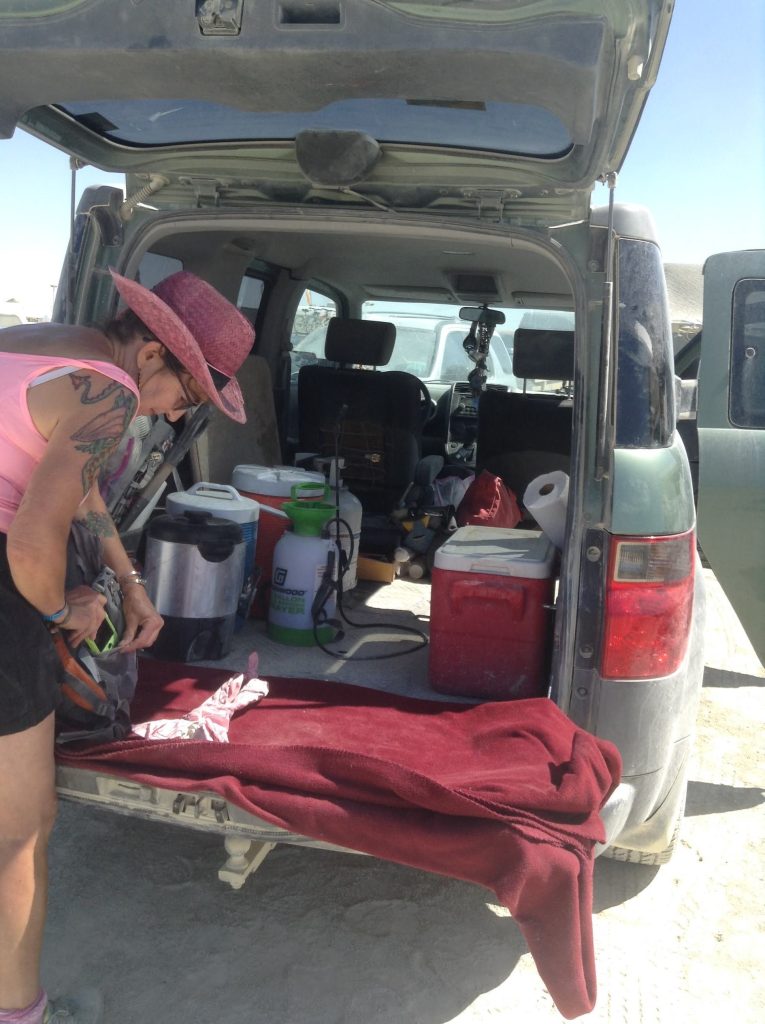
A Honda Element is, in my entirely unbiased opinion, the finest dog transport vehicle ever created by human beings, and I will hear no opposing arguments at this time, but it is also an astonishing little service machine because the seats move, the doors open wide, practically anything can be stuffed inside and, before you know it, you have stopped thinking of the car as transportation and begun thinking of it as a way to get something useful from where it is to where it needs to be.
Food rescue became one of Wanda’s great callings.
Restaurants, stores, events, anywhere there was too much food in one place while somebody somewhere else did not have enough, we loaded boxes and bags and trays and produce and bread and whatever could become dinner instead of garbage into Wanda and carried it to community refrigerators or directly to our unhoused neighbors.
I made music for that too, because feeding people in winter has its own rhythm, loading Wanda until the back disappeared beneath food and blankets while some song I had deliberately chosen played through those old speakers, driving through a sleeping city with coffee in the cup holder and whatever we had managed to rescue behind me, the music keeping company with the work because sometimes service is solemn and sometimes it is joyful and mostly it is simply what you do next.
Winter mattered most.
When the temperature dropped and the city seemed to disappear behind locked doors and heated windows, Wanda carried coffee and food and blankets and socks and whatever somebody might need tonight, not after a meeting, not eventually, not theoretically.
Tonight.
Sometimes the thing a person needed was Wanda herself.
I have let unhoused people sleep inside her.
For twenty-three years I have never locked Wanda’s doors.
Never.
People occasionally hear this and look at me as though I have just announced that I keep my Social Security number taped to the windshield, but I trusted Wanda, I trusted people, and I trusted the magic bubble enough to keep a black and yellow bin inside filled with snacks and useful things anyone could take if they needed them.
I had one rule, written on a note.
Please do not make a mess.
That was it.
Not KEEP OUT.
Not PRIVATE PROPERTY.
Not DO NOT TOUCH.
Please do not make a mess.
There are entire political philosophies considerably more complicated than that which have accomplished less.
Somebody hungry, cold, tired, stranded or needing somewhere safe for a little while could find something inside that ridiculous old Honda, and sometimes Wanda’s service meant driving somewhere while other times it simply meant staying exactly where she was with the doors unlocked.
She made room.
That was what Wanda did.
She made room.
Burning Man simply made that more visible.
Of course Wanda went to Burning Man.
Eventually she became the official vehicle of the Love Beets, which was never formally decided and certainly never voted upon; it simply became true in the way certain things become true after enough years.
Wanda is known on the playa.
I realize that sounds ridiculous.
She is.
There was music for this work too, a CD made specifically for taking care of the artists, because if Wanda was going to cross the playa carrying coffee and electrolytes and cupcakes and grilled cheese and whatever else might make somebody building impossible beauty in impossible heat feel cared for, then obviously she also needed the right fucking soundtrack.
There is another CD in Wanda right now whose only job is arrival.
Not Reno.
Not the highway.
Not Gerlach.
Arrival.
The moment the playa opens in front of us and Black Rock City stops being somewhere we are going and becomes the place we have reached, that CD goes in, because some thresholds deserve their own music and this one always did.
Artists see her coming.
People working in the heat look up and recognize that square, dust-covered Honda moving toward them and know there is a reasonably good chance something useful, delicious, cold, hot or ridiculous is about to arrive.
Electrolytes.
Hot coffee.
Cupcakes.
Ice cream cones.
Grilled cheese, art-side.
You could be somewhere in the middle of a desert working for hours on something enormous and absurd and beautiful, exhausted and covered in dust, look up and see Wanda coming across the playa and understand:
Good things are on the way.
That may be the purest definition of what I ever wanted Wanda to be.
Good things are on the way.
Open the doors, feed somebody, give them water, pour coffee, put on music, figure out what they need, make room.
One night there was a wounded Army veteran who wanted to see the art but used a wheelchair, and the playa is not exactly famous for being uncomplicated when you are traveling by wheelchair.
The chair fit inside Wanda.
He fit inside Wanda.
We fit inside Wanda.
So we went.
I drove him out across the playa at sunset into that impossible temporary city glowing in the darkness and gave him a private tour of the art, and I remember being extraordinarily happy, not because I was helping someone, since that kind of happiness can become a little too pleased with itself, but because for one particular moment in one particular desert I happened to possess exactly what another human being needed.
Not money.
Not wisdom.
Not influence.
A fucking Honda Element.
The chair fit.
So we went.
There are nights in a life whose value cannot be calculated.
That was one.
Wanda was never really an equation.
Buddha rode in Wanda.
Stella rode in Wanda.
Later, Clyde.
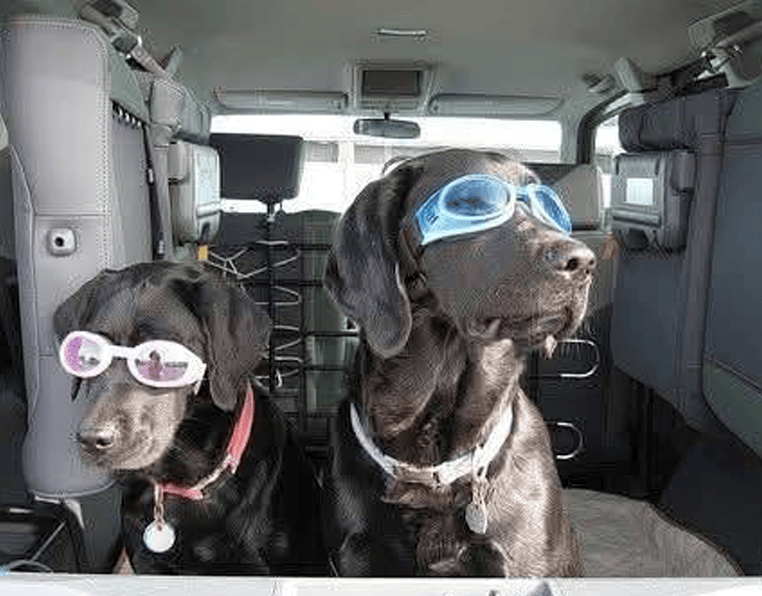
Dogs have slept in that car and waited in that car and stared at me from that car with the specific expression dogs reserve for humans who have stopped somewhere entirely unnecessarily, and after enough years the interior began storing something stranger than dog hair or paw prints.
There are places inside Wanda where I can still see Buddha.
Not hair.
Not a scratch in the upholstery.
Buddha.
There are places where I can still see Stella.
That is different.
This is where writing an obituary for a car becomes very fucking inconvenient, because apparently I am no longer talking about a car.
I am talking about who was alive inside it.
Buddha is gone.
Stella is gone.
Kevin is gone.
Wanda carried things I cannot put back inside her: Buddha and Stella and Kevin, California before I left it, entire summers, certain rivers, people I used to know, versions of myself I cannot return to, all of it somehow having traveled inside those four doors even though there are no straps for those things, no cargo hooks, no clever Honda seat configuration capable of folding memory neatly into place.
Wanda witnessed my life.
Maybe that is what I have been trying to say.
She knew me before Utah and before so much else, when Buddha was alive and Stella was alive and Kevin was still standing in a Santa Cruz dog park, when I could put an Oregon Country Fair CD into the stereo, point the car north and believe without even thinking about it that there would always be another river.
She carried versions of me I cannot go back and retrieve.
Maybe that is what an old object becomes after enough years, not sentimental exactly, but a witness, a storage unit for places and creatures and versions of ourselves that technically no longer exist except that somehow we can still see them when we open a door.
This morning I went outside and found another piece of Wanda lying on the ground.
The college kids had been careless in their reverie the night before and an orange road block had been knocked hard enough into the front passenger side of Wanda to break a piece near the windshield, which they apparently left smashed on the pavement without a note.
Sigh.
I picked it up.
Underneath was playa dust.
Layers and layers of playa dust.
Beneath that, glue.
Of course.
At this point, as I have said, Wanda is held together by playa dust, virtue, and my own heart, with whole sections where the original engineering surrendered years ago and I simply continued believing in her through glue and duct tape and replacement pieces and whatever somebody could rig to keep her moving.
I stood there holding this stupid broken piece of my stupid car, looking at dust that had been sealed beneath it for years, realizing there was an entire desert hiding inside an old repair.
Of course there was.
Wanda has been carrying places around with her too.
Santa Cruz, Utah, Oregon, the playa, roads I have forgotten, roads I will never forget, some of them apparently held together with super glue and dog hair.
The college kids saw an old car.
That is what I keep thinking about.
They hit it, broke something and walked away because they saw an old car.
I saw Wanda.
I stood there in the morning holding another piece of her in my hand, knowing perfectly well that she is a car and discovering once again that knowing this is absolutely no fucking help at all.
I could sell her.
Someone would give me money for Wanda, probably more money than I paid for her in the first place, and God knows I could use money because who couldn’t, but each time I try to imagine assigning a number to Wanda something inside me rejects the premise.
What is the market value of getting Buddha and Stella safely through that storm, or the resale value of all that rescued food, or the going rate for a night when somebody had nowhere warm to sleep and Wanda’s doors happened to be unlocked?
How much is the black and yellow bin worth?
How much for a wounded man and his wheelchair beneath a playa sky?
What is Kevin worth?
Stupid question.
Exactly.
Wanda was never really an equation.
She arrived in my life as a magic gift, so I have decided she should leave it the same way.
I am donating her to the Humane Society of Utah.
The car I whispered into existence because I needed something for Buddha and Stella gets one more act of service on behalf of animals, and I would like to believe, with absolutely no evidence whatsoever, that the magic bubble transfers with the title.
I have also written a love note and tucked it inside Wanda for whoever gets her next, because apparently simply signing over the title is not enough for me; I need whoever opens that note to know that they are climbing into something that has been deeply, ridiculously, extravagantly loved, something that carried dogs and food and children and strangers and friends and entire versions of one woman’s life across deserts and rivers and mountains and impossible snowstorms, something whose doors remained unlocked because I believed trust was worth practicing, something that has spent twenty-three years making room.
I don’t know who will find the note or when they will find it or whether they will read it and think the woman who owned this ancient Honda before them was completely fucking insane, which is fine, because the note is not an instruction manual and it is certainly not a warranty; it is simply a little bit of love left behind in the place where I have already left so much of it, asking whoever comes next to take care of her, let her remain useful, make room when they can, and know that somewhere beneath the stickers and glue and road dirt and playa dust and tumbleweeds of dog hair there is a magic bubble.
I thought perhaps I should tell them.
Just in case the magic needs to know where to go next.
I don’t know how magic works.
There is no box on the paperwork.
MAGIC BUBBLE:
YES.
NO.
Still, I want whoever receives whatever comes next from Wanda to inherit some infinitesimal residue of Buddha and Stella and Kevin, Oregon river water and Utah snow, Bob Weir and playa dust and Love Beets and coffee spilled somewhere I never completely cleaned, all the dogs and children and boxes of rescued food and people who slept inside her, everyone frightened or happy or hungry or simply needing to get somewhere who crossed the threshold of those doors and became, however briefly, part of what Wanda carried.
There is one more thing I am leaving inside her.
A CD.
You think I’m letting her go without a soundtrack?
I have spent twenty-three years making music for the roads Wanda and I were about to travel together, for Oregon and Utah and the playa, for artists waiting in the dust and winter nights when we carried food through the city, choosing songs before I knew exactly what would happen because I always wanted the road to have a soundtrack before the story arrived.
This time I am choosing music for a road I will not take with her.
That is different.
I will tuck the CD inside Wanda with the love note, and whoever comes next may find it tomorrow or six months from now or never, may understand immediately or think it is just another strange artifact left behind by the woman whose political stickers are still fading across the bumper.
They might just throw it away. The only possible thing that stills plays a CD is Wanda’s own ancient excuse for a radio.
But perhaps one afternoon they will be sitting inside this ridiculous square Honda wondering who the hell nakedjen was, notice the disc, slide it into the old player and press PLAY.
I hope they do.
The songs will never ever explain Wanda.
They cannot.
The music can’t preserve what is leaving.
It cannot.
It is more because I have spent all these years choosing songs for departure and arrival, for crossing deserts and state lines and versions of myself, and there is something I cannot bear and something I deeply love about sending Wanda into whatever comes next with music waiting inside her.
A soundtrack for the first road without me.
I won’t know where she is going.
I won’t know who is driving.
I won’t know whether there is a dog in the back or food stacked behind the seats or someone tired enough to need a safe place for the night.
I won’t know what the weather looks like through her windshield.
I won’t know when the song begins.
I just want the music there.
Waiting.
In case somebody hits PLAY.
Shortly, I am going back to Santa Cruz.
Now I have Clyde.
I need a car for Clyde.
That sentence feels familiar.
There will be beaches and dog parks and strangers standing around talking about dogs and weather and whatever else people talk about before they accidentally alter the course of one another’s lives, and I know perfectly well there are sensible ways to purchase automobiles involving websites and dealerships and Carfax reports and interest rates and Harry, undoubtedly, keeping a spreadsheet.
Fine.
I am going to try something else first.
I am going to stand somewhere with Clyde, perhaps on a beach, perhaps in a dog park, perhaps beside someone who has absolutely no idea they are about to become part of this story, and I am going to say the thing out loud.
I need a new car for the dog.
The first time I said it, Kevin heard me.
Twenty-four hours later there was Wanda, and inside Wanda there turned out to be an entire life: Buddha and Stella, California and Oregon and Utah, snowstorms and hot springs and rivers, rescued food and unlocked doors, a black and yellow bin, the Love Beets and the playa, a wheelchair beneath the stars, Bob Weir, coffee, cupcakes, grilled cheese, sunrise, Clyde, me, somehow all of us fitting inside one ridiculous square Honda.
That was home.
That was pure magic.
I don’t know much, but I do know that once, standing in a dog park, I asked the universe for a car for the dogs.
The universe answered.
Her name was Wanda.
- Nakedjen Songs for Wanda
- Can’t Find My Way Home — Blind Faith
- Into the Great Wide Open — Tom Petty & the Heartbreakers
- Blue Sky — The Allman Brothers Band (live)
- Big Yellow Taxi — Joni Mitchell
- This Must Be the Place (Naïve Melody) — Talking Heads (live from Stop Making Sense)
- The Weight — The Band
- People Have the Power — Patti Smith
- I’ll Take You There — The Staple Singers
- Lean on Me — Bill Withers
- Get Down on It — Kool & the Gang
- Genius of Love — Tom Tom Club
- Rapper’s Delight — The Sugarhill Gang
- Celebration — Kool & the Gang
- Burning Down the House — Talking Heads (live from Stop Making Sense)
- Franklin’s Tower — Grateful Dead (live)
- Good Times — Chic
- Lovely Day — Bill Withers
- Wildflowers — Tom Petty
- Brokedown Palace — Grateful Dead
- Dancing Barefoot — Patti Smith Group
- Road to Nowhere — Talking Heads
- Ripple — Grateful Dead