Tag: mental-health

  • The Long Way Around

    I have been unemployed since November, which is a sentence I have repeated often enough that somewhere along the way I apparently started believing it meant I have not been employed, and last night, somewhere between twenty-five students in Indonesia laughing their way through English words some of them had been afraid to say an hour earlier and me sitting here in Salt Lake City trying to convince them that there really, truly, absolutely was NO WRONG ANSWER, I had one of those rather inconvenient realizations about myself that had apparently been following me around for months, patiently carrying the evidence in its mouth, waiting for me to stop moving long enough to see what it had brought me.

    Because what the fuck have I actually been doing since November?

    I worked Sundance, whatever WORK means when the currency is exhaustion and movies and taking care of people; I executive produced a film; I went to Bali where I was supposedly going to repair my nervous system and instead came home carrying villages and people and plans in my pockets; I showed up for graduates in Myanmar; I spent twenty-four days helping search for August; I worked on Purple Alert until it became LAW; I went to Burning Man convinced I had absolutely nothing left to give and then, apparently by muscle memory, kept finding whoever needed water or help or somebody willing to sit down in the dust and stay there for a while. And yesterday, before I taught a room full of people in Indonesia how much fun it can be to get the answer completely WRONG, I somehow found myself talking with someone who might actually be able to help bring solar power to villages there.

    Meanwhile this little creature has been following me around with all of that clenched between its teeth while I keep announcing, to anyone who asks and especially to myself, that I am unemployed.
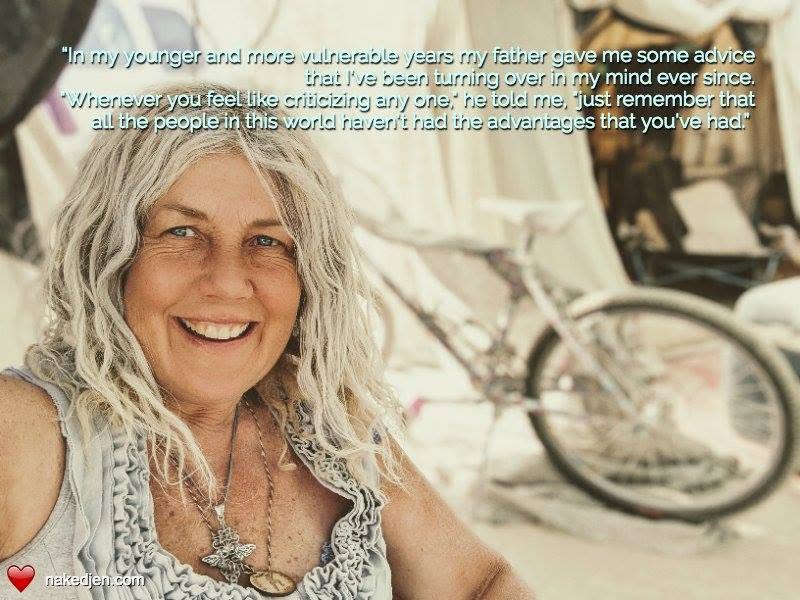
    A smiling woman with long, wavy gray hair sits in front of a bicycle, reflecting on her father's advice about empathy and perspective.

    And I know exactly whose handwriting is all over that particular bit of nonsense.

    ALBERT.FUCKING.NEAL.

    My father grew up on Cape Cod, which explains the accent and nothing else about the man. I grew up at his dinner table, where current events weren’t current events so much as an entrance exam you passed before you were allowed the peas, and I was expected to read the Washington Post and the New York Times every day, know what was on fire in Washington and Moscow and Beirut before supper, then sit down and discuss it with a man who did not care, even slightly, that I was a child.

    I was three.

    THREE.

    Other three-year-olds got applause for knowing the cow says MOO. I was expected to have a position on foreign policy.

    I am the SON my father never had.

    There it is.

    I don’t say that with sadness, or even accusation, because what he handed me at that table was enormous: the conviction that citizenship isn’t a noun, that paying attention is an obligation, that if you’ve been given access, education and a voice, you use them, and that it’s a kind of indecency to know someone is in trouble and decide it isn’t your problem.

    The thing about ALBERT.FUCKING.NEAL is that “that’s great” has never actually been a complete sentence. There is no period after it. There is barely even a comma. You can hear the BUT already warming up in the bullpen while you’re still telling him the good news.

    I could call him from the actual village in Indonesia, standing beneath the first solar panel while twenty-five newly fluent English speakers sang the national anthem and I simultaneously found three missing people and passed another piece of legislation, and somewhere around the time I said, “Dad, you are not going to fucking BELIEVE this,” Albert would already be leaning over the dugout rail waiting for the next pitch.

    “Yeah, yeah, Jennifah, that’s great, BUT WHAT ABOUT…”

    And apparently I learned his punctuation.
    I can put a period after almost anything except my own usefulness.

    Which is how I found myself last night, after those students had spent an hour making me laugh so hard I forgot for stretches of time that I was supposed to be the teacher, already thinking about what I had not done yet. Not what had just happened, not the faces that had changed over the course of the hour, not the student who had started out barely willing to speak and then kept speaking, not the sheer ridiculous JOY of watching people discover that being wrong in English is survivable. I was already somewhere else, mentally circling the next thing, the next problem, the next person who might need me, the next pitch coming in before I had even decided what happened to the last one.

    ALBERT.FUCKING.NEAL’S question, except now I didn’t even need Albert.

    Yeah, yeah, Jennifah, that’s great. But what about…

    What about the job. What about the money. What about Washington. What about the people I haven’t helped yet.

    There is apparently no bottom to WHAT ABOUT.

    And in a little while I will call him and tell him about last night, about the students and the laughter and the fact that I made WRONG the safest possible answer and somehow that loosened the whole room, and I will tell him about the solar conversation too, since that happened yesterday as well and even I have to admit that teaching English in Indonesia and possibly finding a way to get power into villages there is not exactly a wasted Saturday.

    He will listen. He will be proud of me. He will mean it.

    For about eleven seconds.

    Then, somewhere before either of us has quite finished with the good part, I will hear the familiar little turn in his voice.

    “Yeah, yeah, Jennifah, that’s great, but what about Washington?”

    And maybe this time I will say it back.

    “What about FUCKING Washington, Albert? What do you think I can actually do? I think it’s too late.”

    Which is not a sentence I like saying out loud, especially to him, and certainly not one I was raised to say, but there it is anyway, sitting between us like something neither of us ordered and now have to eat.

    And I know ALBERT.FUCKING.NEAL well enough to know that “I think it’s too late” will not buy me even twelve seconds of silence; he will come right back over the top of it with WHAT DO YOU MEAN TOO LATE, as though I have just tried to sneak an unsupported argument past him at the dinner table and he has caught me before I can reach for the peas, and suddenly I will be three and thirty and sixty-two all at once, expected to explain precisely when I think the country crossed whatever invisible line I am talking about, what I have done about it, what I intend to do next and, most importantly, why the hell I am sitting here telling him there is nothing left to be done when there are still people standing up.

    And then, because ALBERT.FUCKING.NEAL is not above bringing in reinforcements, he will say, “Your grandmother would be pushing you out the door, Jennifah!” which is a dirty move, honestly, because once he puts my grandmother in the room I am no longer arguing with one eighty-six-year-old man on the phone, I have generations of Neals at my back apparently wondering why I am still standing in the kitchen talking about how hopeless everything is instead of putting on my fucking BOOTS.

    And the worst part is, I know exactly what he means.

    There are still people standing up.

    So maybe the answer to WHAT ABOUT FUCKING WASHINGTON is that I am out the door, Albert. I have been out the door. The BOOTS are on. I just keep getting waylaid by the actual world before I ever make it to Washington: a missing man, a room full of students, somebody sleeping outside, a village without power, a person who needs me to stay five more minutes.

    I keep stopping. I keep showing up. I keep moving.

    Maybe that is not the route you had in mind for me, and maybe it is not the route I had in mind either.

    Maybe I am taking the long way around, Albert.

    But I am already out the fucking door.
  • Catching My Breath in Bali: Embracing True Hospitality

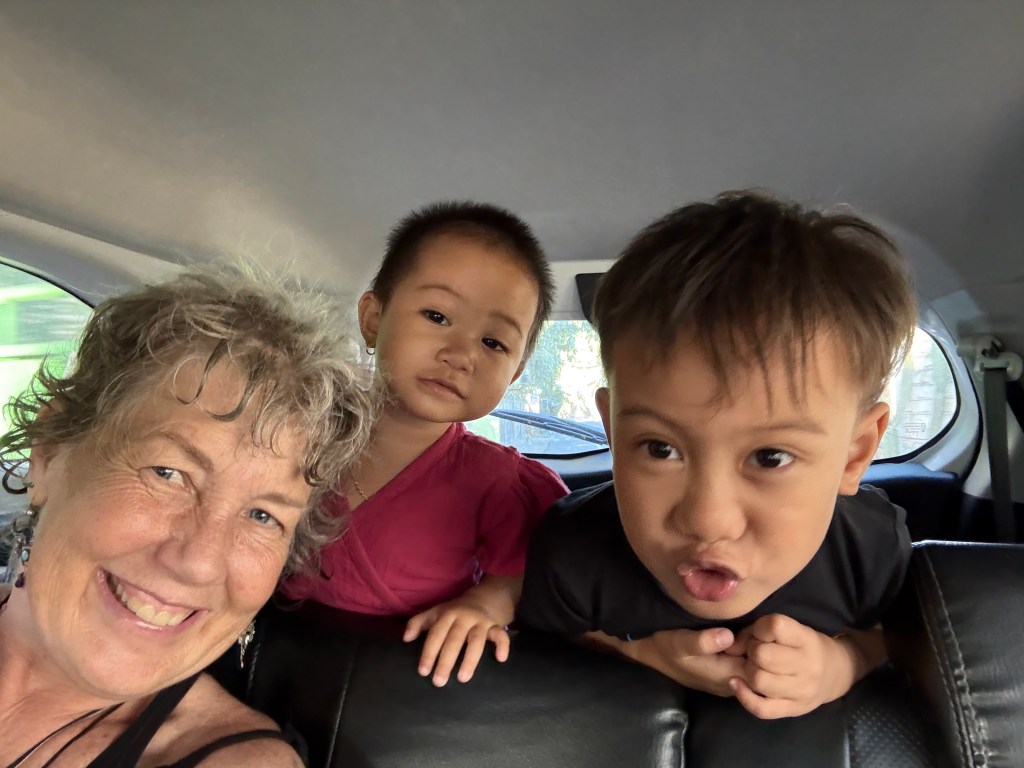
    The Professor said something to me yesterday that I still haven’t been able to shake, we were texting back and forth after I spent the whole day with Ring and his family, and I’d sent him a photo from the backseat of Ring’s car where Ring’s two kids had climbed over the seats to inspect me up close, which honestly felt entirely appropriate — imagine being two or three years old and your dad just casually announces that today you’re bringing home this strange gray-haired American woman with questionable tattoos and an alarming enthusiasm for coffee, and they were completely unfazed by the whole arrangement, didn’t even blink.

    The Professor looked at that photo for about three seconds before he wrote back, “you look different.” Now this is a man who has spent the better part of fifteen years watching my face, he knows every version of me, Festival Jen, Burning Man Jen, Migraine Jen, Grief Jen, the “I’ve had four hours of sleep and somehow we’re still driving with the dogs to Santa Cruz!” Jen — so when he tells me I look different I tend to pay attention. At first I figured he meant happier, or more rested, maybe Bali had finally succeeded where every overpriced moisturizer on earth has failed. Nope. It took me almost a full day to understand what he was actually seeing, which is that I’m breathing. Not metaphorically, not in the inspirational-Instagram-quote way where somebody writes just breathe over a photo of a mountain they’ve never once climbed.  I mean my body has quietly started doing something it stopped doing years ago. I am breathing all the way down into my diaphragm, which is a sentence so absurd I barely believe it myself except my therapist has been trying to convince me of this for years, my friends have been telling me for years, and if I’m being completely honest with you, I don’t really breathe in Utah. 

    That’s maybe the truest sentence I’ve written in a while. I don’t breathe in Utah, I hold my breath there. I hold my breath at the Coffee Garden, which is probably the safest place I’ve ever known — think about how wild that is, Alan and Dieter built this beautiful little sanctuary full of artists and misfits and queer kids and old professors and everybody who’s ever felt like they don’t quite fit anywhere else, and even there, some ancient part of my nervous system remained unconvinced we were safe enough to fully exhale.

    Trauma is such an exacting little bitch. It doesn’t just build memories, it builds posture, it rearranges your shoulders, it decides where you’re going to carry your jaw, it teaches your lungs to negotiate with oxygen like there’s a shortage. It whispers don’t get too comfortable, don’t relax completely, stay ready, something is coming — and the infuriating part is that after enough years you stop even noticing you’re doing it, holding your breath just starts to feel like breathing, you adapt, because human beings are spectacular adapters, we can normalize almost anything if you give us enough time. Apparently we can normalize living on tiny little sips of oxygen. Who knew?!  Not me. Not until Bali.

    Every morning here I wake up before the sun, and I genuinely could not tell you where the sun comes up from on this particular corner of the island because islands are wonderfully confusing that way, ocean over there, jungle over there, temples everywhere, my internal compass has basically shrugged and said good luck. I pull on my Converse and my yoga pants and head out before most of Ubud has even opened its eyes, though the birds have not only opened theirs, they’ve apparently called for a full choir practice, there is so much birdsong here it you wonder if you should start learning the tunes. As daylight begins to break through, the women carrying canang sari, those tiny woven offerings made out of palm leaves and flowers and gratitude and intention appear like apparitions and then the sweeping begins — god, the sweeping, I have become completely enchanted by the sweeping. Every single morning somebody is quietly taking care of something, a doorstep, a temple, a sidewalk, a family shrine, and nobody is doing it for applause, nobody’s particularly interested in documenting it, it’s just what you do before the day starts, you prepare your little corner of the world for whoever might pass through it. I keep wondering what America would feel like if we spent less time yelling at each other online and more time sweeping.

    Yesterday Ring picked me up. Actually — that’s not even true. Yesterday Ring and his family made room for me. Those are two completely different sentences. His wife was there, his two beautiful kids were there, and we drove from Ubud to Sanur for the kite festival and an afternoon at the beach, which is only twenty-seven kilometers away and somehow took three glorious, ridiculous, completely unhurried hours, and if you’ve never been to Bali that probably sounds impossible and if you have been here you’re already laughing. The traffic is legendary, scooters flowing around cars like schools of fish, entire families balanced on one bike in a way that, honestly, makes you HOLD YOUR BREATH, temple ceremonies just appearing out of nowhere, trucks stopping, dogs wandering across the road like they own the place, which, honestly, they absolutely do. Nobody seemed particularly bothered by any of it, least of all Ring, he just drove, and we talked, and the kids climbed over the seats to tell me very important things I only understood about half of, though I’m fairly sure I agreed to several imaginary adventures and possibly promised to play the important role of a superhero at some point.

    The thing that really got me wasn’t even the kite festival, though the kite festival was magnificent, giant creatures sailing across an impossibly blue sky while whole families gathered on the beach cheering them on, joyful in that deeply communal way that feels rarer and rarer these days. But that wasn’t the point. The point happened in the car, somewhere between the villages and the rice paddies and the scooters and the little roadside temples draped in black and white cloth, when it hit me that Ring wasn’t giving me a tour, he was giving me his entire Thursday, his family, his kids, six hours of a life that already belonged to people he loves. He wasn’t spending time on me, he was sharing it with me, and there is a difference so enormous I still don’t quite have the language for it. I’ve spent so much of my life being the one who takes care of everybody else that I almost didn’t recognize what was happening — I’ve been the Fluffer, the doula, the organizer, the woman carrying snacks in her backpack because somebody’s inevitably going to need almonds, the one who remembers birthdays and medications and spare phone chargers and where everybody parked the damn car. I know how to be that person, it’s one of my love languages. What I apparently don’t know how to do is be cared for without feeling like I owe somebody an apology for the inconvenience of it.

    This is exactly what Bali keeps insisting on. Sit down. We’ve got you for a while. Drink your espresso. Walk your ridge. Ride with our family. Breathe. We’ll sweep, we’ll make the offerings, we’ll show you where the ocean is, you just be here. Maybe that’s why I look different in that photo, not because Bali changed me but because for the first time in a very long time my nervous system believes someone else is standing watch, and it doesn’t have to, not today, not for these few precious weeks.

    Maybe that’s what hospitality actually is. It’s not luxury, it’s not five-star hotels or infinity pools or welcome drinks with orchids floating on top, it’s someone quietly convincing your body that it’s finally allowed to exhale. This is what we’ve always done for each other at our very best, long before social media, long before airplanes, long before passports and guidebooks and algorithms and all this noise we’ve built around ourselves — we made room. Around a fire. Around a table. In the backseat of a little car driving across Bali with two curious kids and a man named Ring who probably has no idea he just handed a tired American woman something she couldn’t have found in any guidebook on earth.

    He gave her back her breath.  He let her exhale. 

    Now that… that feels like a story worth carrying home.

  • The Maps Are Written Across Our Hearts

    The Maps Are Written Across Our Hearts

    Every year when June rolls into July, some part of my nervous system starts looking for Interstate exits, and I do not mean this metaphorically, although perhaps I do because the older I become the more difficult it is to separate the actual road from the one that has been unspooling inside me since 1986, that long ribbon of asphalt and possibility and bad coffee and improbable miracles and the certainty that somewhere beyond the next exit ramp there would be music, or friends, or a circus, or a field, or a dog, or a broken transmission, or Jerry Garcia himself sitting quietly at the center of the whole strange wheel asking us all, quite gently, just how much freedom remained in America and whether we intended to use it.

    July has always felt less like a month and more like a tuning fork struck somewhere deep inside the rib cage, because the body remembers before the brain does, and somewhere around the end of June my internal compass begins spinning wildly, looking for truck stops and ticket stubs and glove compartments full of maps that no longer exist, wondering where the circus is setting up this year, where the bands will bandaloop, how many angels can dance on the head of a pin, whether there is coffee at the next exit, whether there is pie, whether there is a field nearby where tired travellers can throw down sleeping bags and look up at the stars and ask one another the really important questions, such as where did the dog go and who has jumper cables and is there an extra ticket and when exactly did we all decide that strangers were dangerous.

    The Grateful Dead taught me one version of America.

    The parking lot was an experiment, a temporary city appearing overnight on asphalt and empty grassy fields and grilled cheese and optimism, a place where money occasionally mattered and occasionally disappeared altogether, where miracle tickets materialized from thin air and somebody always seemed to have an extra sandwich or an extra blanket or room in the van, where your transmission could fall out in Indiana and a garage owner would stay awake all night teaching you how to repair your own car while his wife fed you dinner and you slept in a cornfield beside the garage listening to the stalks whisper like the Pacific Ocean, and where eventually you discovered that gifts do not come with strings attached, that miracles are often folded inside free tickets, that somebody stops when you are broken down, that somebody shares what little they have, that somebody teaches you how to repair the engine instead of repairing it for you, and that no matter where you go, there you are.

    The Oregon Country Fair taught me another version. Same song, perhaps, but a very different verse.

    You entered through the gates and somebody hugged you and stamped a peach on your arm and said, in one way or another, welcome home, and eventually I tattooed that peach onto my own skin because some religions require baptism and some require communion and some simply place a peach upon your arm and send you wandering through the trees with music and art and children and ice cream and impossible ideas about how human beings might live together if they chose kindness over commerce and curiosity over fear, and somewhere beneath those magnificent fir trees you begin to understand that home is not a place at all but a practice, something we make for one another, something we carry, something we offer.

    In the between times, I found another temporary city in the desert, and what it taught me was not terribly different from the parking lot or the Fair. Build the city yourselves. Bring what you need. Share what you have. Somebody always runs out of water. Somebody always loses their camp. Somebody always breaks down. Somebody always sits beside somebody else beneath impossible stars on what feels like a truly impossible precarious piece of art and says, “I’ve got coffee. Tell me what happened.”

    The band plays its final song. The parking lot empties. The Fair does a final sweep. Jerry dies. The dust doesn’t stay. The map disintegrates in the glove compartment.

    This is what I have been talking about all along.

    The maps.

    Not the maps on our phones. Not the blue dot telling us exactly where we are every moment of every day. I mean the old maps. The Rand McNallys folded into impossible shapes and stuffed into glove compartments until the creases finally split. The state lines and county lines and interstates and back roads and roads that simply ended in gravel and dust and faith.

    My maps.

    The weathered notebook that always traveled beside me, filled with health food stores and diners willing to make grilled cheese after ten o’clock and pay phones that still worked and the woman in Eugene with the extra couch and the basement in Ohio that somehow held all of us and the garage in Indiana and the kitchens where we could always make more sandwiches and fill our coolers with ice and beverages before heading back out onto the road.

    The attic in Pittsburgh where a gaggle of filthy hippies once landed and laughed until morning and where years later, after the roads had bent and folded and delivered me back there carrying an entirely different version of myself, somebody I loved quietly helped put me back together again.

    Those were my maps. Not red states. Not blue states. Not electoral maps. My maps are made of people. The people who stopped. The people who stayed. The people who answered the phone. The people who wrote their numbers on the back of a ticket stub. The people who said, “Call me if you need anything.” The people who said, “If you’re ever passing through.”

    I know this is why our Americas all look different.

    Mine looks like parking lots and Oregon forests and dusty roads and kitchens full of soup and coffee and dogs and people making sandwiches.

    Yours may look like a fishing dock off the coast of Maine. A church basement hosting an NA meeting somewhere in the Carolinas. Your grandmother’s porch with a view. A diner serving pie all night at Exit 141. A station wagon headed west. Or East. Or to catch a baseball game in an endless summer of baseball games. Pick-up trucks to pick up a stray dogs because they need a place to call home.

    The shape of our America is the shape of our own hearts.

    The maps are written there.

    The lines still run from mine to yours and from yours to somebody else and from theirs to a frightened stranger standing beside a highway wondering if anybody will stop.

    I really believe that is what the country has always been.

    Not the lines we draw between ourselves.

    The names we write beside them.

    So, here we are. All of us together inside the largest and strangest experiment of them all.

    America.

    Somewhere, probably even right now, somebody is sitting beside a dark highway with their hazard lights flashing. Somebody is lost. Somebody is afraid. Somebody is wondering if anyone will stop. And somewhere else, perhaps only a mile away, perhaps at the next Interstate exit, perhaps sitting at a kitchen table drinking coffee, perhaps reading this very thing by the light from a cellphone at 2:13 in the morning somewhere outside Winnemucca somebody is already reaching for their keys.

    We all have our roads. We all have our lines. We all have our maps.
    And we all have our exits.

    This is another thing the road taught me. You never really know which exit is yours. You pass hundreds of them. Thousands. Rest areas and truck stops and little towns with one blinking light and pie shops and motels and places you promise yourself you’ll visit someday, and then one day you find yourself taking an exit you never expected because your transmission gave out or your heart broke or somebody got sick or somebody died or somebody called and said, “Can you come?”

    We ride with our hands on the wheel and our hearts beating in our chests and we simply do not know. We do not know if the next exit is ours, or the one after that, or the one two thousand miles down the road. That uncertainty is not the frightening thing. It is the reason for everything.

    I do not know where my exit is, and you do not know where yours is, and America herself does not know where hers is, the whole point is simply how we choose to travel. Choose to show up.

    We do stop. We share our sandwiches. We find the lost dog. We answer the phone. We write our numbers in the margins and on the backs of ticket stubs. We make coffee. We put our hands over our own hearts. More importantly, we put our hands on the hearts of others and ask, “Still beating?”

    Babump.

    Babump.

    Still there.

    This? This is what America needs from us right now. Not spectators. Not passengers. Not people standing beside the road arguing over the map while the engine overheats.

    AMERICA is sitting there herself with her hazard lights flashing and one hand pressed against her chest, and perhaps what she is asking is exactly what every frightened traveler has always asked somewhere beside a dark highway in the middle of the night.

    Is anybody coming?

    Yes. We are. Because this is our country. This is our map. This is our heart.

    The lines still run from my heart to yours and from yours to someone else’s and from theirs to a stranger sitting beside a road somewhere wondering whether anybody will stop.

    And someday, though none of us knows when, we will each take our own exit. Maybe tomorrow. Maybe thirty years from now. Maybe somewhere we never expected. Maybe somewhere we’ve been driving toward all along.

    So while we’re here — while the engine is still running and the coffee is still warm and the maps are still folded in the glove box and the names are still written in the margins and the kitchen lights are still burning and the hearts are still beating — we might as well show up.

    We might as well keep each other breathing.

    That’s it. That’s the whole assignment.

    America needs all of us right now. Every last one. And if you call yourself an American — if you put your hand on your heart and mean it — then that means you.

    So pull over. 💜

  • POOF!

    I am known, in some circles, as a fairy.
    The Beet Fairy.

    For years, Vive supplied the cold-pressed beet juice that quite literally helped keep me on this planet. Not as a luxury. Not as a lifestyle accessory. As medicine. As ritual. As one of those stitched-in things your body comes to trust before your mind has even caught up.

    This morning I was waiting for my juice delivery.

    Then it didn’t come.

    So I did what so many of us do now when something beloved suddenly slips sideways. I went looking for the answer myself. No text. No email. No little human tap on the shoulder. Just absence. A missing delivery. Then the quiet discovery that after nearly thirteen years, Vive Juicery had closed.

    That was how I found out.

    No goodbye. No handoff. No soft landing. Just poof.

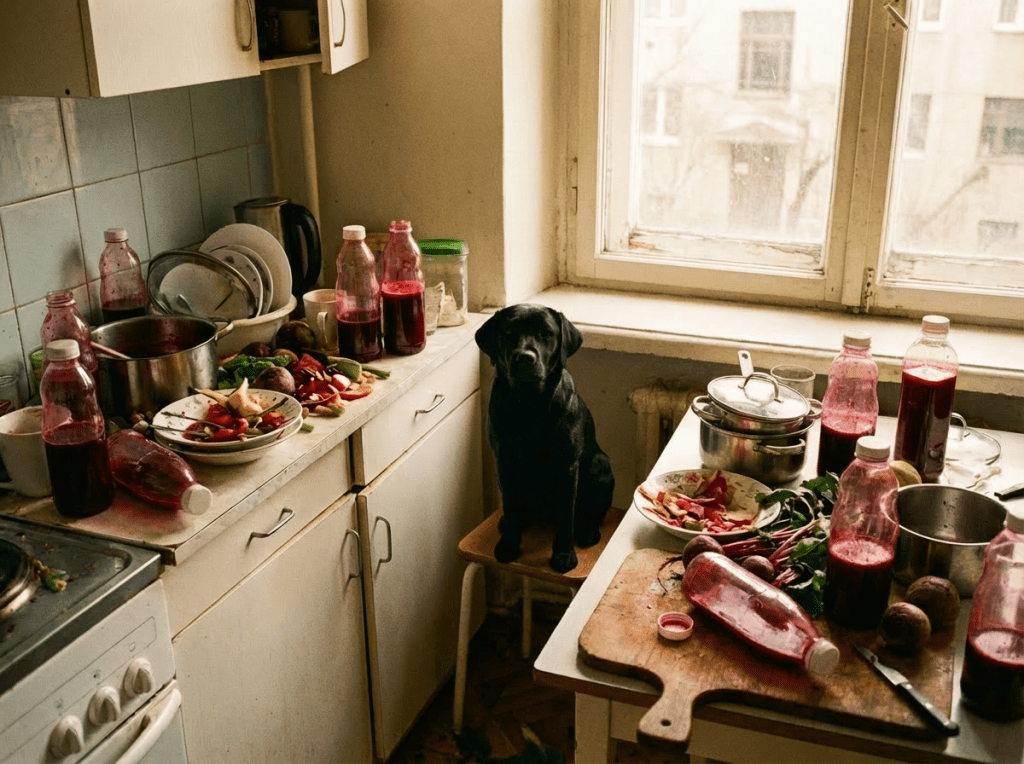
    Black Lab sitting on a stool in a messy kitchen covered with beet juice bottles and vegetable scraps.
    A black lab sits calmly amidst the delightful chaos of a kitchen covered in beet juice and vegetable scraps.

    Maybe that is why it hit the bruise so directly. I am apparently still one giant exposed nerve ending over being let go from the acupuncture clinic in much the same fashion. Another Irish Goodbye. Another community I was inside of until suddenly I wasn’t. Another place where I did not get to say goodbye. Another thread cut so cleanly it somehow bled more.

    I have not recovered from that.
    Not really.
    Maybe not at all.

    I miss helping.

    I miss it with a force that startles me. I miss it in the marrow. I miss it like phantom limb pain. I miss the direct, human, ordinary holiness of being useful to another person in real time.

    Yes, I still help. I help all over the damn place. I help in line at Coffee Garden. Let me sort out the pastry case with you. Tell me what kinds of sweets you usually love. Let’s find what’s just right.

    I help at the Apple counter at Costco, explaining to a stranger that the employee doing spreadsheets, shipping, data sheets, all of that, probably does not need the spaceship. The graphics or web person absolutely does. Get the more robust machine. Get the memory. Get the AppleCare. It is a business expense anyway, right?

    I help at Warby Parker like it is my god damned job, choosing frames for a woman I have never met as though her future face is somehow my responsibility.

    I keep doing this. Everywhere. Like some feral customer service department roaming the earth in search of purpose.

    I miss people.
    I miss service.
    I miss usefulness.
    I miss the tiny spark that passes between two people when one says, “Can I help?” and the other one exhales, relieved, because the answer is yes.

    I miss the community of helping.
    I miss the rhythm of it.
    I miss the feeling that my care had somewhere to go.

    Yes, I gather signatures. Yes, I show up. Yes, I speak up for affordable housing, for democracy, for the vulnerable, against cruelty, against ICE, for all the jagged broken-hearted things that matter. I do all of that.

    This is different.

    This is the grief of not getting to be of use in the ordinary, intimate, daily ways that once shaped my life. The grief of no longer being inside the circle of care. The grief of being built to help, only to find yourself standing there with your hands still full of help, nowhere to set it down.

    So when eight little bottles of juice did not appear on my porch this morning, it was not just a delivery glitch. It was one more vanishing. One more touchstone gone quiet. One more place where continuity dissolved without a goodbye.

    That sounds dramatic, maybe. Grieving a juice company. Fine. Call me dramatic. I am not really grieving juice. I am grieving what happens when the small, reliable rituals that hold a person together simply stop speaking. I am grieving the shock of finding out that something woven into the fabric of your life has quietly slipped out of the loom. I am grieving the way endings arrive now with no witness, no handoff, no human warmth.

    This is what I keep thinking about:

    We are living in an Irish Goodbye economy.

    Businesses vanish.
    Communities vanish.
    Jobs vanish.
    People vanish.

    You are in relationship, however imperfectly, until suddenly you are not. You are of use until suddenly you are outside the door. You are waiting for the thing that has reliably arrived, until it doesn’t. Then you are left to piece together the ending by yourself like some emotional raccoon rooting around in the dark for context.

    I understand all the arguments. Protect your peace. Preserve your energy. No one owes everyone every explanation. I know. I really do. I understand that people are tired, burned out, underwater, overextended, one hard conversation away from becoming a puddle in public.

    Still.

    At what cost?

    At what cost do we keep disappearing from one another like this?

    Trust is not built in grand gestures. Trust is built in continuity. In small acknowledgments. In the dignity of a heads-up. In the simple human instinct to say: hey, this is ending. Thank you. You mattered here.

    When that does not happen, something erodes.

    Not just loyalty.
    Not just goodwill.
    Something softer. More essential.

    The belief that we are actually in this together.

    That may be why so many of us feel so untethered right now. Yes, the world is on fire. Yes, democracy feels like a folding table in a windstorm. Yes, we are out here gathering signatures, speaking up, protesting, trying to keep one another fed, sheltered, seen.

    Underneath all of that, another grief hums.

    The grief of disappearing from one another.
    The grief of institutions, workplaces, businesses, communities, all using the language of care or family or service or belonging right up until the moment they evaporate.
    The grief of no goodbye.
    The grief of no witness.
    The grief of being left holding love with nowhere to place it.

    Maybe that is why I keep helping strangers in random retail environments like a woman possessed. Maybe I am trying to stitch myself back into the human fabric one tiny interaction at a time. Maybe I am trying to prove that service still exists. That tenderness still exists. That someone can still look another person in the eye, say, “I’ve got you,” and mean it.

    I wanted my juice this morning.
    Yes.
    More than that, I wanted continuity.
    I wanted the medicine to keep medicining.
    I wanted one small beloved thing to arrive exactly as expected.
    I wanted not to lose one more thing.

    Instead, I got another lesson in impermanence. Another reminder that the world can change shape while you are standing in your Uggs on the porch.

    Thank you, Vive, for the years you nourished me.
    Thank you for the medicine when it was medicine.
    I mean that.

    This hurt.

    Deeply. Weirdly. More than I would like to admit.
    Yet not weird at all, really.

    Sometimes eight missing juice bottles are not eight missing juice bottles.

    Sometimes they are every goodbye you did not get.
    Every room that went dark without warning.
    Every place you poured your care that disappeared before you could say:

    I was here.
    I loved this.
    This mattered to me.

  • Still Here. Barely.

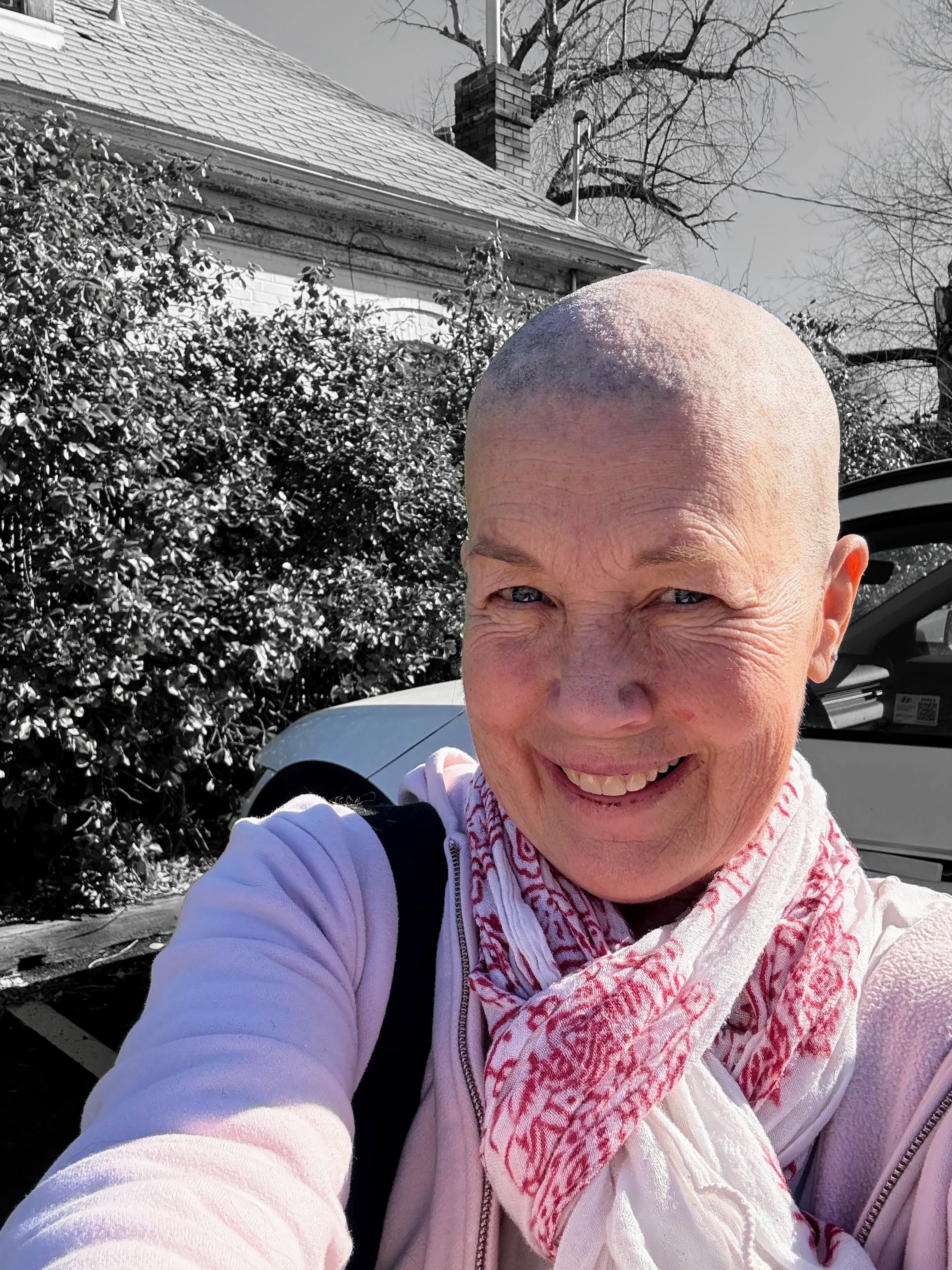
    I shaved my head last Monday.

    Not for fashion. Not for a dare. Not for reinvention as some shiny little brand strategy.

    I did it because my body needed a receipt.
    Because my heart kept whispering, we are letting go now, and I needed my scalp to sign the paperwork.

    Gizmo died.

    Sundance ended. Not just the festival, but the way of it here. The particular Utah snowglobe version where I knew the back hallways, the green rooms, the secret shortcuts, the faces that needed feeding, the ones that needed a tissue, the ones that needed a firm hand on the shoulder and a “drink some water, babe, I’ve got you.” Ten days of taking care of everyone… and then suddenly the lights go out and you’re standing in a quiet room full of empty chairs, holding a lanyard like it’s a relic.

    And Burning Man? I closed that chapter too. I am not going back this year. I can feel the hinge click. I can feel the door seal. I can feel the desert wind on the other side and I’m not stepping into it. I’m finished. I’m choosing something new even though I don’t yet know what “new” looks like.

    Also, because life has a sense of timing that is either comedic or cruel (or both), my credit card got compromised. So this morning I drove to the bank, bald as bald can be, and I started thinking about what it would be to make a documentary of my life.

    Not the highlight reel. Not the montage where the camera pans across costumes and concerts and glamorous chaos.

    More like… the witness list.

    Because if you really wanted to tell the story of me, you would have to find the people I have helped along the way. The ones who would say: she showed up. She filled the gap. She made it happen. She walked into the mess and started organizing the corners. She brought the water. She brought the snacks. She brought the extra phone charger, the spare hoodie, the peppermint oil, the hand on your back when you were about to fold.

    I’m the fill-in-the-blank fairy.

    Sundance Fairy.
    Fluffer Fairy.
    Share Your Sandwiches Fairy.
    Missing-person search Fairy.
    “Let me just handle it” Fairy.
    “Here, eat something” Fairy.
    “Breathe with me” Fairy.

    And I never, ever, ever accept payment. I have built an entire life on the belief that if I keep giving, the universe will keep providing, and maddeningly… it does. It really does. Doors open. Tables appear. Someone hands me exactly what I need right when my hands are empty.

    I’ve trusted that so hard that it became my religion.

    Even back on Grateful Dead tour, even in those long-ago days when everything was loud and wild and starry and half-improvised, I was still taking care of people. I made Clyde’s Cookies on tour, vegan, organic chocolate chip cookies, because I needed a way to support myself, yes, but also because it was a survival mechanism. A nervous system strategy. A way to stay steady in the swirl. A way to love people and the planet at the same time. Those cookies ended up in cafés all over Santa Cruz even when the Dead weren’t touring. Little brown-sugar love letters in a world that moves too fast.

    I have been in service most of my life. I don’t say that with a halo. I say it with the honesty of someone who knows service can be both medicine and the perfect hiding place.

    Because here’s the part I’m trying to tell the truth about:

    Right now, I feel broken.

    Like… really broken.

    Not “I’m having a hard day” broken. Not “I just need a bath and a nap” broken.

    More like: I cry over silly things. A song lyric. A dog on a porch. A stranger’s hands. The way light hits a kitchen counter. I cry because my heart is full of endings and my body doesn’t know where to put them. I cry because I can’t fix any of the big things right now, and I am a person who has built a whole identity around fixing. I just can’t seem to find the Nakedjen superglue AND the duct tape.

    The world is hurting. It really and truly is. There is a real revolution happening and I am paying attention. I am not looking away. I can feel the instability in the air like static. I can feel the grief in the streets. I can feel the fear. I can feel the fire. Sometimes it feels like the whole planet is holding its breath, waiting to see who will choose cruelty and who will choose care.

    I want to be the person who chooses care.

    I am still that person.

    I’m just… shaky.

    I’m alive, but barely. Tender as an overcooked beet. Raw in a way that surprises me. Not numb, not detached, not checked out.

    Just open. Too open. All nerve endings.

    So this is me, leaving a little note on the community bulletin board of the internet:

    Hi. It’s Nakedjen.
    My head is bald. My heart is bruised. I’m still here.
    I don’t know what’s wrong with me, but I know something is happening in me. Something is changing shape.

    If you’re reading this and you’re also crying in grocery store aisles, or feeling oddly fragile in the parking lot, or standing in the doorway of your own endings… come sit by me.

    No fixing required.

    Just the quiet promise that we are not alone in this, even when we feel like cracked glass.

    And if the universe has been kind enough to keep meeting me in the moments when I’m empty, then maybe it will meet me here too.

    Maybe it will meet all of us here.

    One breath at a time.

  • Afterwords

    I’m not here to write about how August was found.
    That story is already orbiting the globe, carried by hearts far larger than mine.
    What I need to write — what I must write — is how these last 24 days rearranged me from the inside out.

    Because something in me changed.
    Shifted.
    Cracked open like a geode that didn’t know it was full of light.

    For 24 days, this city — this state — this strange and stubborn place we call home — showed up with a force I was not prepared for. I’ve lived here long enough to be grumpy about it. Long enough to feel like Utah and I have an ongoing feud. But let me tell you something with my whole chest:

    Don’t tell me this city ain’t got no heart.
    I heard it beating. Loud. Unified. Unstoppable
    .

    People I had never met became my family.
    People who shouldn’t have had time made time.
    People who were exhausted kept going.
    People who had nothing still gave everything.
    People who live outdoors — who navigate survival every damn day — carried the torch with a clarity and grace that humbled me to my knees.

    Yesterday, on a hunch that didn’t make sense on paper but burned in my gut, I drove to Redwood Road. I walked into the pockets of humanity we call “the unhoused community,” gently, respectfully, palms open.

    I didn’t demand.
    I didn’t accuse.
    I didn’t interrogate.

    I said, softly, “I know the code. If you’re helping him, you have your reasons. He’s an adult. You don’t owe me anything. But his mother is on day 24 of her own hell, and she just needs to know her son is alive. Please. Let him know she loves him. Let him know it’s okay to check in. That’s all I’m asking.”

    And something changed in the man standing in front of me — not his posture, but his energy.
    It was like watching a lantern ignite behind his ribs.

    He looked at me steady and said,
    “I’ll make sure your message gets where it needs to go.”

    I clasped my hands.
    I bowed my head.
    I whispered, “Thank you.”
    And I walked away.

    Hours later, August was found.
    Not because of me —
    because collective care is a force of nature.

    Because Salt Lake City —
    in all its contradictions, its rough edges, its quiet resilience —
    showed the hell up.

    Because people who live outside, who are dismissed and overlooked and judged daily, were the ones who held the line with the most dignity and strength. They are the heroes of this story.
    Say it out loud.

    And let me tell you what all of this did to me:

    I have been the Chief Love Beet my whole life.
    I show up.
    I take care of people.
    I fix the things I can.
    I hold the ones I love.
    I drag my glittery boots into the dark and try to make it lighter.

    But this?
    This was different.

    This time, I wasn’t the one holding the container — the container held me.

    Salt Lake City held me.
    The volunteers held me.
    The mothers held me.
    The grievers held me.
    The searchers held me.
    The unhoused community held me with a kind of honor I will never forget.

    We cracked our hearts together like a chorus of fault lines.
    We refused to give up.
    We refused to look away.
    We refused to let “impossible” have the last word.

    I am changed.
    I can feel it.
    A new chamber in my heart, carved by 24 days of strangers-turned-family, by the hum of hope vibrating through every street, by the relentless love of a mother who would not stop.

    August is alive.
    And so, somehow, am I —
    in a way I wasn’t before.

    Thank you, Salt Lake City.
    Thank you to every single person who loved outside their bodies.
    Thank you to those who showed up even when it felt impossible.
    Thank you to our unhoused brothers and sisters who carried this story with honor.
    Thank you to the fierce, unshakeable ache that binds us as humans.

    This wasn’t a search.
    This was a remembering.

    We belong to each other.
    Still.
    Always.
    Especially when the world forgets.

  • 💜 Purple Alert: Why I Still Search for August

    💜 Purple Alert: Why I Still Search for August

    People keep asking me why I’m still searching for August.

    Here’s the truest answer I have:
    Because I can. And because I hope you would, too.

    Because if your heart beat just a little louder —
    if you heard a tremor in the universe,
    a missing pulse,
    a soft human who hasn’t come home —
    I like to believe you’d go looking.

    Even if you didn’t know him.
    Even if he was 29, grown, and complicated.
    Even if the world insists adulthood equals safety.
    (Trust me, it doesn’t.)

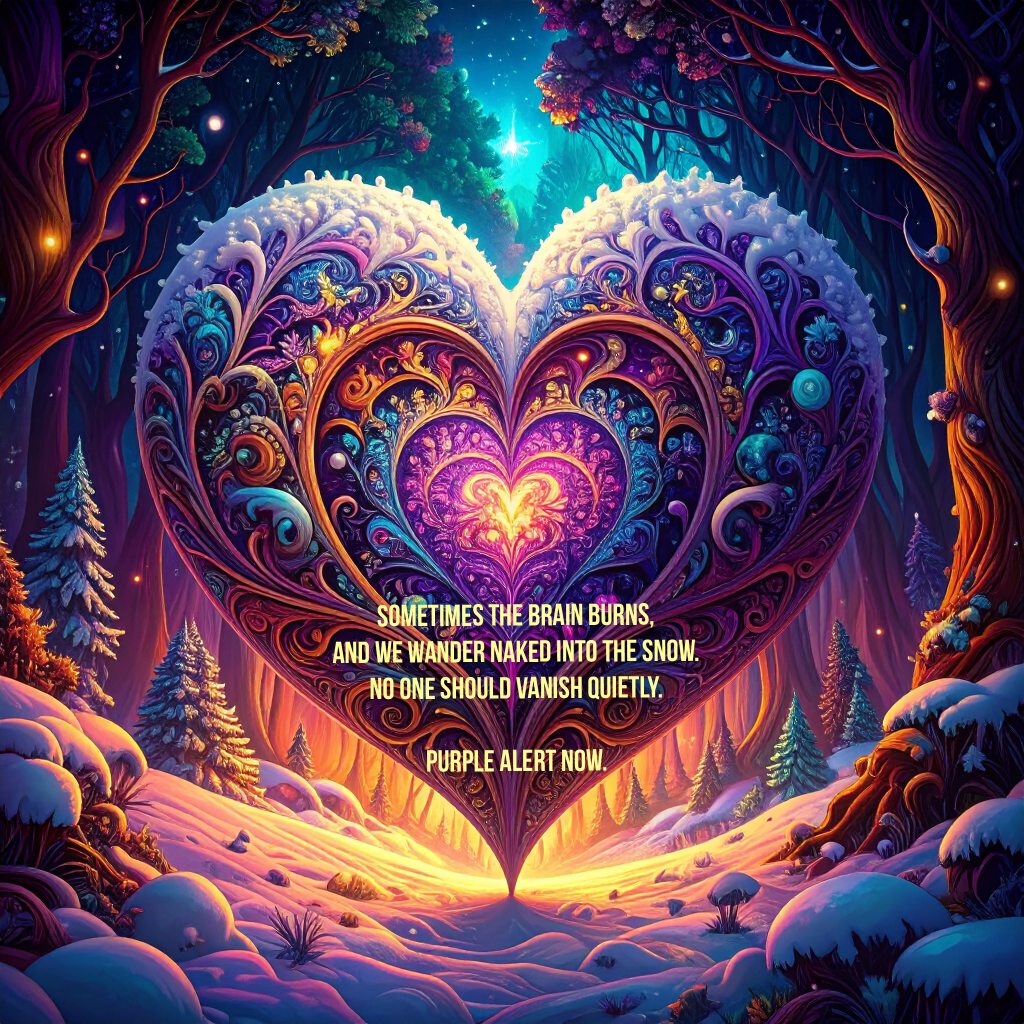
    Sometimes a brain goes haywire.
    Sometimes it lights itself on fire.
    Sometimes a person walks away naked into the snow
    and doesn’t even know they’re gone.

    I know this because once — I was the one who wandered.


    New Year’s Eve, 2008

    (which was technically still 2007 because time is a suggestion)

    I had just moved to Salt Lake City.
    A blizzard.
    No friends yet.
    Just two black labradors — Buddha and Stella —
    who carried my heart on eight paws like it was their holy job.

    I don’t remember the seizures.
    I only remember becoming conscious in the snow.
    Naked. Disoriented. Freezing. Alone.

    Not metaphorically.
    Actually and literally wandering the city,
    no memory of how I got there,
    no idea where “home” even was.

    I saw the glow of a Smith’s supermarket.
    Closed. Empty.
    But a payphone in the vestibule leaked just enough light
    to feel like a lifeline.

    I remembered one number.
    Collect.
    My mother.

    “Mom… I’m naked and cold and I don’t know where I am.”
    “Jennifer, you’re in Utah.”
    “Why would I do THAT?”

    She called emergency services from Maryland.
    She told them where to find her daughter
    wandering state-newborn and soaked in snow.
    They found me.
    They wrapped me in blankets.
    They got me home.

    And when we arrived?
    Every single light in my house was on.
    Front door wide open.
    Two dogs sitting guard — waiting.
    Holding vigil over whatever was left of me.

    If I hadn’t found that payphone,
    if I hadn’t seen those lights,
    if Buddha and Stella hadn’t anchored me to this world,
    if — if — if —

    I could have disappeared.
    Forever.
    Just like that.

    No alert. No network.
    No hey Utah, one of us is missing — go look.

    That is my WHY.

    That is why I search for August.
    Because someone should.
    Because his mother deserves not to wonder.
    Because he deserves to be alive and found if he wants to be.

    Because there is a world where that night was me
    and nobody knew to sound an alarm.


    Utah doesn’t have a PURPLE ALERT.

    But it should.
    Every state should.
    A Purple Alert for adults who wander,
    who are neurodivergent or vulnerable or lost in the fog of a burning brain.
    Not a punishment.
    Not a trap.
    Not a “gotcha.”

    Just a net.
    A community rally.
    A lifeline in the snow.

    It is not a miracle.
    But it could save one life.
    And that is enough.

    I have systems now.
    Layers.
    If I go missing again — alarms will go off.
    Texts will fly.
    People will look.

    Not everyone has that.

    August doesn’t have that.

    He is missing.
    Still.
    And I’m not ready to stop searching.

    If you’re reading this, you don’t have to know August to care.
    You just have to remember something simple:

    There was a night I could have been the one you were searching for.

    And every mother deserves to sleep knowing
    that if her child wanders naked into the snow —
    a city will rise like hands to catch them.

    💜 Utah deserves a PURPLE ALERT.
    💜 August deserves to be found.
    💜 And any one of us could be next.

    If this moved you — share it.
    Talk about Purple Alerts.
    Help me make noise.

    We’re still looking for August.
    Let’s not stop.

  • Breaking Up Is Hard To Do

    (or why my nausea finally makes sense)

    Yesterday, I did one of the hardest things I’ve done in a long time.
    I walked into the clinic where I have poured more than a decade of my life—my heart, my care, my precision, my sparkle—and I walked out for the last time.

    Just me. My bag. My dignity.
    And Clyde waiting for me at home like the good boy he is.

    I left my keys.
    I left a thank you note.
    And I left behind every single one of my crystals—my crystals, the ones that have been tucked gently in spaces there and through a thousand seasons of patients and stories and healing and heartbreak.

    But those crystals were humming with the clinic’s energy now, not mine.
    They vibrated with all the unspoken tension and the gaslighting and the quiet “it’s not you, it’s me” nonsense that became the soundtrack of too many broken promises.
    They weren’t mine anymore.

    I walked out without them.
    A conscious uncoupling from quartz.

    Here’s the part that feels like a cosmic joke: I had nausea before I went.
    The kind where you feel like your throat is closing and your stomach is in a fist and your body is whispering:

    “We don’t belong here anymore.”

    My body knew.
    It always knows.

    By the time I returned the keys, I felt everything—
    the heartbreak, the betrayal, the relief, the exhaustion, the “finally.”

    And then this morning—because the Universe has the comedic timing of a drunk circus clown—I got a text from the clinic upstairs.

    They were confused. People were showing up for a Tai Chi class that wasn’t happening at the clinic—because why would it be? It’s happening at the new qigong school.
    And they didn’t have my boss’s number.
    OF COURSE THEY DIDN’T.

    They texted me, because even without me there, I’m still the one who fixes everything. The one who knows. The one with the answers.

    I had to tell them, “I don’t work there anymore.”
    And then, because I’m me, I gently guided the lost Tai Chi humans to the correct location.
    Because kindness costs nothing and I refuse to abandon confused people in a parking lot.

    But I didn’t forward anything to him.
    Not my problem.
    Not my circus.
    Not my qigong monkeys.

    My professor joked this morning that he’s waiting for the inevitable front-page New York Times feature, because, well… the last time a man blindsided me and walked out, it did end up splashed across the national news.

    But this? No.
    He doesn’t get that kind of press.
    He doesn’t get a think piece.
    He doesn’t get a photo.
    He doesn’t get my rage or my heartbreak or my spotlight.

    He gets… silence.

    The same silence he gave me.

    What he does get is a tiny footnote in the book of my life:
    a bad-juju boyfriend I should have broken up with earlier,
    a lesson in boundaries I clearly needed,
    and the reminder that when the Universe wants you out, it will make you sick to your stomach until you listen.

    So here I am.
    Waking up today without keys, without crystals, without the weight of a place that could not hold me.
    My nausea is gone.
    My anxiety is quiet.
    Clyde snored on my feet all night in full approval.

    I know this much now:
    I didn’t lose anything.
    I got my freedom back.
    This is the messy, painful, holy part of the story where the door closes so loudly you jump…
    and then realize you’re already walking toward the door that’s opening.

    I’m okay.
    Better than okay.
    I’m free.

    xo,
    nakedjen